Jensen Huang's Timing Story Continues: What NVIDIA's Latest Results Add to the Picture
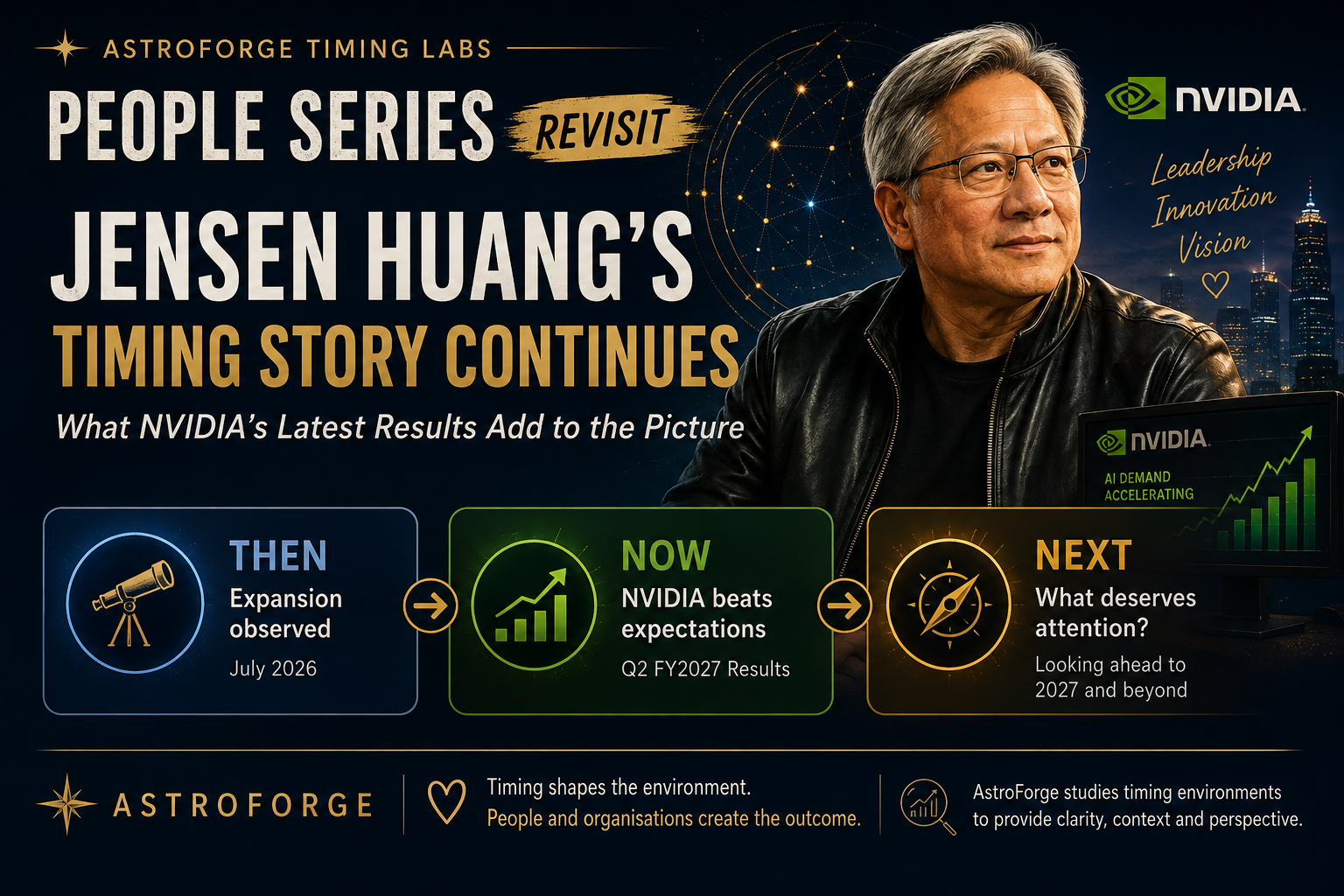
In July, AstroForge published People Series Case Study #002 , examining Jensen Huang’s long-term leadership journey through the lens of timing.
At the time, AstroForge observed a strongly supportive expansion environment around Huang — one that appeared to favor growth, opportunity and the ability to build on foundations already created.
Since then, NVIDIA has reported another stronger-than-expected quarter.
So rather than beginning a new analysis from scratch, this revisit asks a simpler question:
How do NVIDIA’s latest developments fit the timing environment AstroForge had already observed — and what may deserve attention next?
What We Observed Then
The original Jensen Huang case study did not suggest that success would simply continue without resistance.
Instead, AstroForge identified a timing environment characterized by strong expansion signals alongside the need to keep building, adapting and carrying increasing responsibility.
The broader interpretation was that Huang appeared to be entering a particularly supportive period for growth — but that the value of such an environment would still depend on execution, innovation and the ability to turn opportunity into something sustainable.
That interpretation was published before NVIDIA’s latest earnings report.
What Happened Since
NVIDIA has now reported fiscal second-quarter results that again exceeded Wall Street expectations.
Revenue reached approximately $96.2 billion, while adjusted earnings per share also came in ahead of expectations. Data Center revenue remained the dominant driver, reflecting continued demand for AI infrastructure.
More importantly, NVIDIA’s outlook suggested that the company itself expects the current AI investment cycle to remain unusually strong.
The company guided toward roughly $108 billion in revenue for the next quarter and offered a longer-range outlook pointing to continued rapid growth into the following fiscal year.
Jensen Huang’s message was similarly confident: AI demand is broadening, infrastructure investment remains intense, and more companies are moving from experimentation toward real economic use of AI systems.
At the same time, the environment is not free of pressure. Supply constraints, rising component costs, competition and geopolitical uncertainty remain part of the picture.
How Does This Compare With the Earlier Timing Picture?
The latest developments appear broadly consistent with the expansion environment AstroForge had already observed.
The important point is not simply that NVIDIA delivered another strong quarter.
It is that growth continues to be supported by foundations built over many years — CUDA, AI infrastructure, developer ecosystems, partnerships and NVIDIA’s position at the center of the current AI investment cycle.
That fits the earlier interpretation particularly well:
Growth appears strongest when it is built on structures already in place rather than created from nothing.
In that sense, NVIDIA’s current momentum looks less like a sudden breakthrough and more like the continued realization of foundations built over a much longer period.
What AstroForge Says Now
A fresh research-only timing extraction for Jensen Huang, generated without using NVIDIA earnings, stock performance or business news, continues to describe his current environment as expansionary.
The present pattern combines strong growth signals with structural support — an environment that tends to favor forward action on well-prepared goals and continued development of foundations already established.
In simple terms:
The environment still appears supportive of expansion, but the quality of the structures carrying that expansion is becoming increasingly important.
What Deserves Attention Next?
The most interesting part of the current timing picture may not be the strength visible today.
AstroForge identifies an approaching structural-testing period beginning around early 2028. That does not necessarily imply decline. Instead, it suggests that commitments, systems and foundations built during the current expansion may increasingly need to prove their durability.
A secondary context layer adds an earlier note of caution as 2027 approaches, particularly around teams, organisational responsibilities and the working environment.
That creates an interesting transition in the story.
The question may gradually shift from:
How much more can NVIDIA grow?
toward:
Can the people, systems and structures supporting that growth carry what NVIDIA is becoming?
Further ahead, AstroForge sees another transition around early 2029, when the environment begins moving from maximum expansion toward greater stabilization and consolidation.
The Story Is Still Developing
NVIDIA’s latest results do not prove that timing determines outcomes.
But they do give us another real-world chapter against which an earlier AstroForge interpretation can be examined.
So far, the story remains remarkably coherent: strong expansion, substantial opportunity, and growing responsibility around the structures required to sustain it.
The more interesting question now may not be whether Jensen Huang can continue creating opportunity.
It may be whether NVIDIA can reinforce the organisation around that opportunity strongly enough for the next stage.
Timing shapes the environment. People and organisations create the outcome.
AstroForge studies timing environments to provide an additional perspective on real-world developments. Its interpretations are intended to complement — not replace — fundamental analysis and independent judgment.
Share this article
Try the system
Where are you in your life timing?
Generate a structured reading of your current phase — based on long-studied life cycles.
Explore Your Life Timing →