AstroForge People Series — Case Study #002: Can Timing Patterns Help Explain Long-Term Leadership and Innovation? (Jensen Huang)
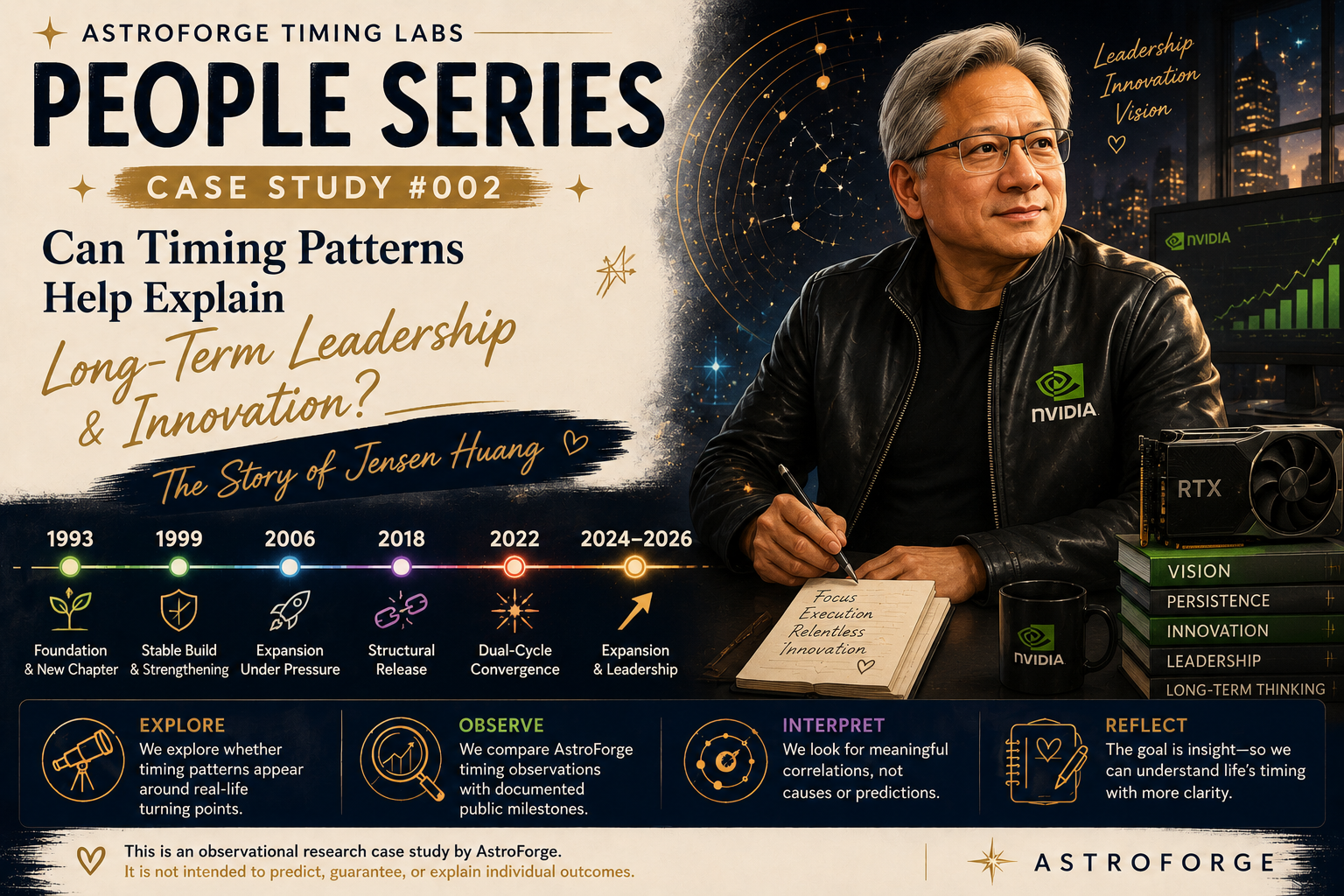
Research Question
Can long-term timing patterns identified by AstroForge meaningfully correspond with decades of innovation, leadership, and business transformation?
In this second AstroForge People Series case study, we examine the public career of Jensen Huang, co-founder and CEO of NVIDIA. Rather than attempting to explain his achievements, we ask a different question:
Do independently generated timing environments show meaningful correspondence with major documented turning points throughout his career?
This research is observational. It is designed to explore recurring timing patterns rather than predict or explain individual outcomes.
Why Jensen Huang?
Jensen Huang represents an ideal research candidate because his professional journey spans more than three decades, with clearly documented milestones covering company formation, technological breakthroughs, periods of uncertainty, and global leadership.
His career provides an opportunity to evaluate whether AstroForge identifies changing timing environments across long-term development rather than isolated events.
Major Turning Points Observed
| Year | Documented Public Milestone | AstroForge Timing Observation | Contextual Reading |
|---|---|---|---|
| 1993 | Co-founded NVIDIA | Saturn Return — Structural Foundation | Beginning a long-term leadership chapter built on responsibility and commitment. |
| 1999 | NVIDIA listed on NASDAQ | Stable Build | The environment supported strengthening rather than rapid transition. |
| 2006 | CUDA platform introduced | Expansion Under Pressure | Growth emerged while requiring sustained technical investment and execution. |
| 2018 | Recovery following cryptocurrency downturn | Structural Release | Moving away from previous constraints toward renewed momentum. |
| 2022 | Artificial Intelligence acceleration begins | Dual-Cycle Convergence | Multiple long-term timing environments aligned during a period of strategic transformation. |
| 2024–2026 | Global AI leadership | Expansion Phase | A supportive environment for continued growth, leadership and strategic influence. |
What AstroForge Observed
Across Jensen Huang's career, AstroForge did not identify isolated moments of success. Instead, it identified a sequence of changing timing environments corresponding with different stages of long-term leadership.
The early 1990s highlighted structural responsibility and the establishment of long-term foundations. Later periods reflected sustained development rather than sudden change, followed by broader expansion as NVIDIA's technological influence increased.
One particularly interesting observation occurred around the early 2020s, where multiple major timing cycles converged while NVIDIA entered a period of global significance driven by artificial intelligence.
Rather than indicating a single event, AstroForge described an environment supporting larger-scale strategic expansion.
What Additional Context Revealed
Alongside AstroForge's independent timing observations, an additional contextual timing framework was examined for research purposes.
Unlike AstroForge, which focuses on long-term timing environments, the contextual layer highlights which areas of life appear to receive greater emphasis during different periods.
Across Jensen Huang's documented career, the contextual layer consistently reinforced the broader interpretation produced by AstroForge. Periods associated with company formation, technological leadership, business partnerships, recognition, and long-term strategic growth frequently appeared within domains emphasizing career, responsibility, partnerships, and public achievement.
While this contextual layer is not currently part of AstroForge's public interpretation model, observations from this case study contribute to ongoing research exploring whether additional context can consistently enrich future interpretations.
Research Interpretation
This case study suggests that AstroForge identified several meaningful changes in timing environments corresponding with major documented transitions throughout Jensen Huang's career.
Importantly, AstroForge does not claim these environments caused NVIDIA's success.
Leadership, innovation, execution, market conditions, technology, and countless external factors all contribute to real-world outcomes.
Instead, this research explores whether long-term timing environments provide additional context for understanding how different chapters of life may present different opportunities and challenges.
The Current Chapter
AstroForge currently identifies Jensen Huang as remaining within a broadly supportive long-term environment.
Rather than signalling a specific future event, the current timing suggests continued emphasis on leadership, strategic positioning, and long-term development.
Whether future milestones occur will continue to depend upon decisions, execution, innovation, and external circumstances.
Timing describes the environment—not the outcome.
What This Case Study Suggests
This second published case study strengthens the emerging observation that independently generated timing environments can meaningfully correspond with documented life transitions.
As with every AstroForge People Series publication, this remains an observational study rather than evidence of prediction or causation.
Future case studies across different professions will continue testing whether these observations remain consistent.
What Does Your Own Story Look Like?
Jensen Huang's journey represents one documented public life.
Everyone experiences different timing environments.
The question is not whether your life will look the same.
The question is:
What chapter is your timing entering now?
Generate your free AstroForge Life Timing Report to explore your own long-term timing environment.
Share this article
Try the system
Where are you in your life timing?
Generate a structured reading of your current phase — based on long-studied life cycles.
Explore Your Life Timing →