Elon Musk’s Next Chapter: Could 2026–2027 Bring Greater Support for What He Has Built?
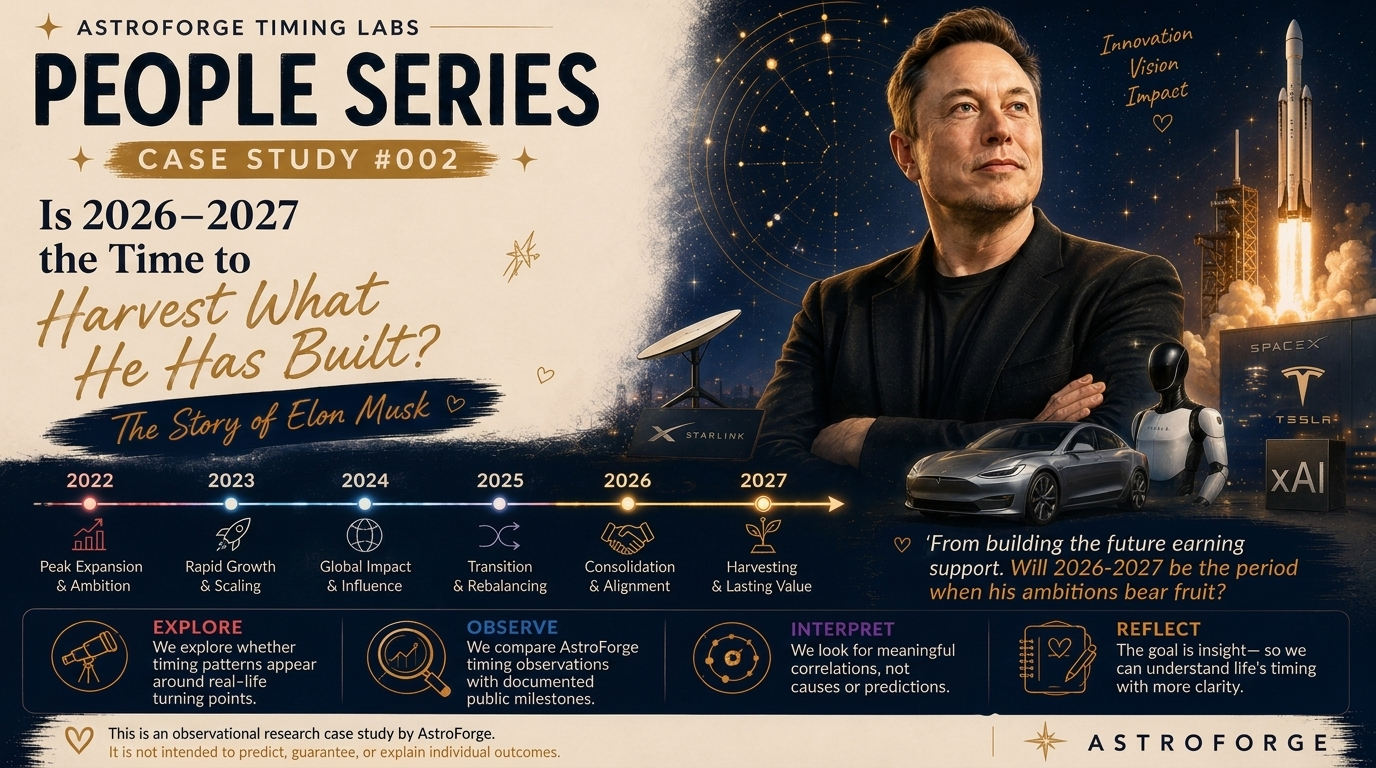
Elon Musk’s Next Chapter: Could 2026–2027 Bring Greater Support for What He Has Built?
Elon Musk has spent recent years building across electric vehicles, artificial intelligence, robotics and space technology. AstroForge suggests that 2026–2027 may bring a more supportive environment for consolidating those ambitions, attracting confidence and strengthening the alliances needed to carry them forward.
Could this become the period when the world begins responding more positively to what he has already built?
Building Was Only the First Test
Elon Musk’s ambitions are no longer concentrated in one company or one industry.
Tesla continues developing electric vehicles, artificial intelligence and robotics. SpaceX has expanded launch operations and satellite infrastructure. X and xAI have added communication platforms and artificial intelligence to an already complex network of businesses.
These projects required years of investment, risk-taking, experimentation and structural change. Some have already reached enormous scale. Others are still attempting to move from ambitious ideas into stable and widely adopted systems.
But building something ambitious is only the first test.
Eventually, every major project reaches a different stage:
Will other people believe in it strongly enough to support it?
Investors decide whether to continue committing capital. Customers decide whether to adopt the products. Partners decide whether to build alongside them. Governments and institutions decide whether to cooperate, regulate or resist.
The public also decides whether the wider vision deserves its confidence.
From Expansion to Consolidation
AstroForge interprets timing as an environment rather than a guaranteed outcome.
Musk’s preceding period carried the characteristics of strong expansion: ambitious development, rapid change, major commitments and the replacement of older structures with new ones.
That type of environment can support building, experimentation and bold movement. But timing environments do not remain unchanged forever.
Moving through 2026 and 2027, AstroForge suggests that the emphasis becomes less about expanding at the same speed and more about consolidating, integrating and strengthening what already exists.
This does not mean that Musk will stop creating new ideas. It means that the more important question may shift.
The next phase may be judged less by how many new projects he announces and more by whether his existing projects gain the confidence, adoption and coordinated support required to become durable.
Could 2026–2027 Be a More Supportive Period?
Based on the timing pattern alone, AstroForge interprets the coming period as comparatively supportive.
Supportive does not mean effortless. It does not mean every project succeeds, every investor agrees or every challenge disappears.
It means that the environment may offer stronger conditions for:
- Attracting confidence around existing businesses and projects
- Strengthening strategic partnerships and alliances
- Converting earlier development into more stable results
- Encouraging wider adoption of products already being built
- Recovering from pressure without losing the larger direction
This is why 2026–2027 may be particularly important.
Musk may not need to prove that he can imagine another ambitious future. He has already done that repeatedly.
The more revealing test may be whether other people are increasingly willing to participate in that future.
A Possible Harvesting Phase
A harvesting phase does not mean receiving rewards without further effort.
It is the period when earlier choices, investments and structures begin producing clearer consequences.
Ideas developed during expansion face the market. Systems built under pressure are tested for durability. Large investments begin revealing whether they can create lasting value.
For Musk, that may increasingly depend on:
- Whether customers adopt the products his companies have developed
- Whether investors maintain confidence in long-term ambitions
- Whether business and technology partners strengthen his projects
- Whether institutions and governments provide cooperation or resistance
- Whether his organisations can turn experimentation into reliable operations
Seen this way, harvesting is not simply about financial reward.
It is about discovering which parts of what he built are ready to gain wider support and which parts still require adjustment.
The Next Test Is Confidence
Musk is often presented as an individual force, but projects of this scale cannot succeed through one person alone.
Artificial intelligence, robotics, transportation, satellite networks and space infrastructure all require complex systems of cooperation.
They depend on engineers, leadership teams, investors, suppliers, customers, regulators, governments and strategic partners.
AstroForge’s interpretation suggests that these relationships may become especially important during the coming phase.
Stronger support could help earlier ambitions become more stable, practical and productive. Weakening confidence or resistance from important groups could limit how much value those ambitions ultimately create.
The opportunity may therefore lie not only in what Musk built, but in whether he can maintain the alliances and public confidence needed to carry it forward.
What This May Mean for People Watching His Businesses
Some readers may naturally ask whether this timing interpretation is positive for people considering involvement with Musk’s businesses.
From the timing perspective alone, 2026–2027 appears more supportive for confidence, cooperation and consolidation than for uncontrolled expansion.
That could create a more constructive environment for people deciding whether to partner with, support, adopt or commit resources to projects that have already been developed.
However, AstroForge does not evaluate financial value, company fundamentals, market pricing or investment risk. A supportive timing environment is not the same as a recommendation to invest.
The timing interpretation simply suggests that confidence, alliances and coordinated support may become more available or more influential during this period.
Whether that potential becomes real will still depend on execution, leadership, market conditions and the quality of the businesses involved.
What AstroForge Suggests for 2026–2027
Elon Musk’s 2026–2027 timing pattern suggests a potentially supportive harvesting phase in which the value of what he built during the preceding expansion period may depend increasingly on confidence, public acceptance, strategic alliances and coordinated support.
If those forms of support strengthen, this period may help convert ambitious development into more durable results.
Existing projects could gain greater acceptance, partnerships may become more valuable and earlier investment may begin producing clearer outcomes.
If that support does not develop, even highly advanced ideas may struggle to reach their full potential.
The timing environment appears constructive, but the response to that environment still matters.
What Should We Watch?
The most revealing developments may not be announcements of entirely new projects.
They may be signs that existing projects are gaining the support required to endure.
- Do Musk’s companies attract stronger strategic partnerships?
- Does public adoption begin matching the scale of their ambitions?
- Do investors show greater confidence in projects already under development?
- Can different companies and technologies work together more effectively?
- Do existing projects begin producing more stable and repeatable results?
- Can Musk maintain support while managing regulatory and reputational pressure?
These are the areas through which the coming timing environment may become most visible.
What Might Your Own Timing Be Asking of You?
Musk’s situation is unusually large, but the underlying question is familiar.
Some periods are suited to beginning, expanding and taking risks. Others are better used to consolidate, strengthen relationships and discover which earlier efforts are ready to produce results.
A person can have strong ideas and work hard, yet still face an environment that requires patience, adjustment or support from others.
At another time, the environment may become more receptive—allowing earlier effort to gain confidence, cooperation and momentum.
The challenge is recognising which environment you are entering.
AstroForge explores that question by examining the timing patterns surrounding your current chapter—not to dictate what will happen, but to help you recognise what may deserve your attention.
Timing shapes the environment. It does not determine the outcome. But understanding the environment may help you respond more intentionally.
Share this article
Try the system
Where are you in your life timing?
Generate a structured reading of your current phase — based on long-studied life cycles.
Explore Your Life Timing →