Apple Has Been Here Before. Is a Remarkable Timing Pattern About to Repeat?
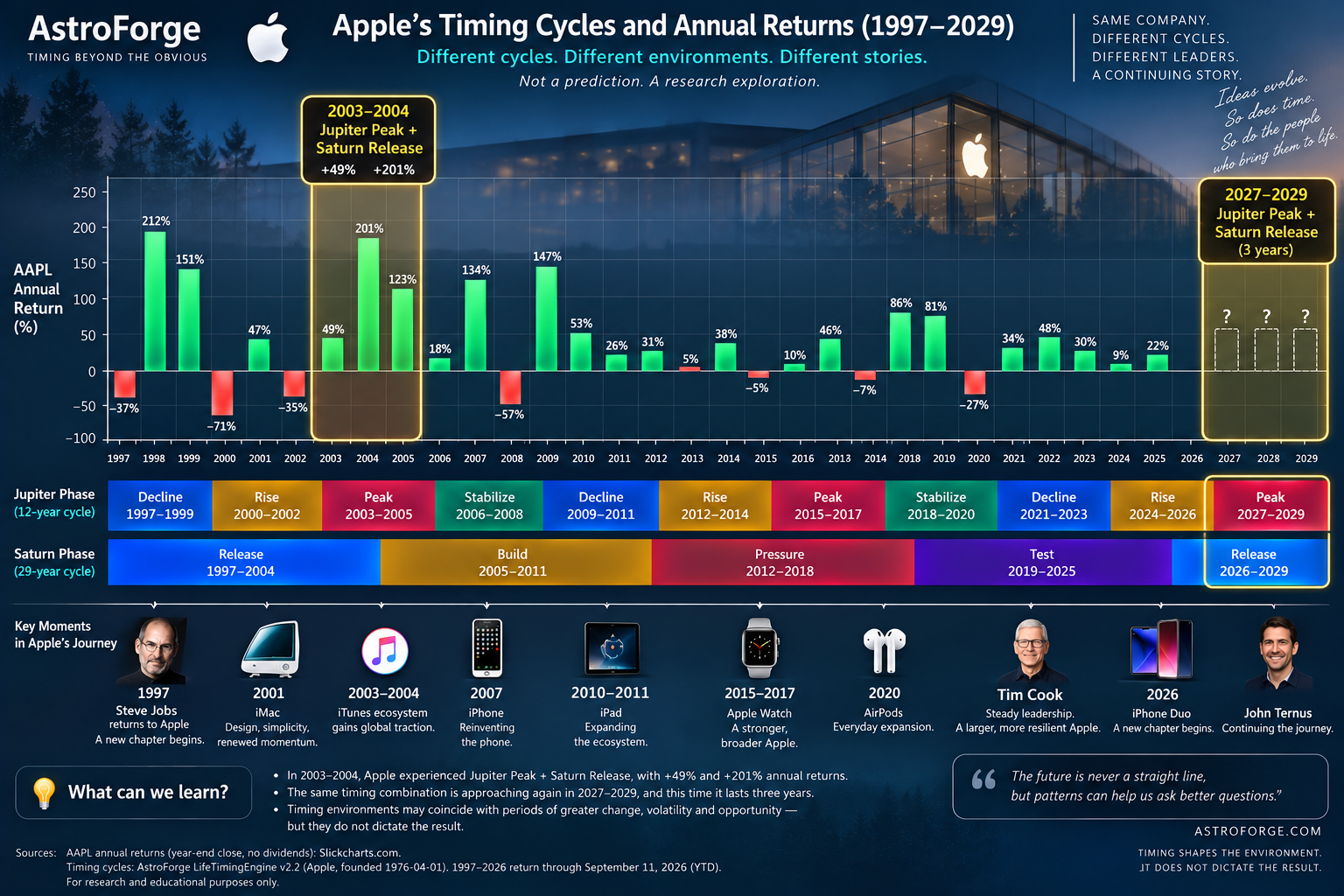
More than two decades ago, Apple moved through a timing combination that now stands out when we look back at the company’s history.
In 2003–2004, Apple was in what AstroForge describes as Jupiter Peak + Saturn Release — a combination of maximum expansion alongside structural release.
During those two years, Apple’s share price recorded annual returns of approximately +49% in 2003 and +201% in 2004.
Now something interesting is approaching.
Beginning in 2027, Apple enters the same Jupiter Peak + Saturn Release combination again.
But this time, the overlap lasts not two years — but three: 2027, 2028 and 2029.
Apple Has Been Here Before
The interesting part is not simply that Apple’s share price performed strongly during 2003 and 2004.
A two-year stock-market result is far too small a sample to claim that a timing combination causes a particular financial outcome.
What makes the period worth revisiting is what was happening around Apple itself.
Steve Jobs had returned to Apple in 1997, several years before the Peak + Release period began. The company that entered the early 2000s was very different from the struggling Apple he had returned to.
Products such as the iMac and iPod were changing Apple’s identity. The iTunes ecosystem was expanding. The company was increasingly moving beyond the traditional personal-computer market.
And several years later, that broader transformation would ultimately lead to the original iPhone.
We should be careful with the chronology here.
The iPhone was not launched during the 2003–2004 Peak + Release period. It arrived in 2007.
So AstroForge is not suggesting that Peak + Release “produced the iPhone.”
The more interesting observation is that this timing environment appeared during a period when Apple was already undergoing a significant expansion and transformation of what the company could become.
What Does Peak + Release Mean?
AstroForge does not treat Jupiter and Saturn as simple “good” or “bad” indicators.
They describe different parts of the timing environment.
Jupiter Peak represents a period in which expansion, opportunity and growth potential are at their strongest within the Jupiter cycle.
Saturn Release represents a period of structural transition — releasing older patterns, constraints or frameworks as one longer Saturn cycle approaches renewal.
Together, the combination can be described as:
Expansion alongside release — an environment where opportunity may be increasing while older structures are being cleared or transformed.
That does not tell us what Apple will do.
It tells us what kind of environment Apple may be entering.
And Now the Combination Is Returning
Apple entered Saturn Release again in 2026.
Its Jupiter cycle is currently still in Rise — an emerging-growth phase — but in 2027 Jupiter moves into Peak.
That creates another Jupiter Peak + Saturn Release overlap:
2027 → Peak + Release
2028 → Peak + Release
2029 → Peak + Release
This is what makes the coming period particularly interesting from an AstroForge research perspective.
The previous clean occurrence lasted two years.
The next one lasts three.
A Different Apple, A Different Leadership Era
Of course, the Apple entering 2027 is not the Apple of 2003.
Its scale is different. Its product ecosystem is different. Its competitive environment is different. Technology itself has changed dramatically.
And Apple is also beginning another leadership chapter.
John Ternus became CEO in September 2026, with Tim Cook moving to Executive Chairman after a long and highly consequential period leading the company.
That transition does not mean Ternus is “another Steve Jobs.”
Nor would it make sense to expect the next Apple era to reproduce the previous one.
But there is an intriguing parallel.
Jobs returned to Apple before a period in which the company expanded beyond its previous identity.
Ternus now begins his CEO tenure just before Apple enters another extended Peak + Release environment.
And almost immediately, Apple has introduced a new chapter for the iPhone with the iPhone Duo — its first foldable iPhone.
Whether that becomes a transformational product, an incremental extension of the existing ecosystem, or something else entirely remains to be seen.
That uncertainty is exactly why this case is interesting.
What About Apple’s Share Price?
The historical numbers naturally attract attention.
During the previous clean Peak + Release period:
- 2003: approximately +49%
- 2004: approximately +201%
Those are extraordinary returns.
But AstroForge is not treating them as a forecast for 2027–2029.
Our broader review of Apple’s historical timing cycles shows clearly that stock returns do not simply rise whenever Jupiter is strong, nor fall whenever a timing environment appears more difficult.
Markets respond to earnings, expectations, valuation, products, competition, macroeconomic conditions, investor sentiment and countless other factors.
The timing environment is only one lens.
So rather than asking:
“Will Apple’s stock repeat what happened in 2003–2004?”
we think the more useful research question is:
“When the same timing combination returns, what kind of Apple will emerge from it?”
This Time, We Can Watch It Before It Happens
This is also what makes the case different from most historical analysis.
We already know what happened in 2003 and 2004.
We do not know what will happen in 2027, 2028 or 2029.
The timing structure, however, is already known.
That allows us to put the observation on record before the outcome exists.
Over the next three years, we can watch what changes inside Apple.
We can observe its products, leadership, strategy, competitive position and — yes — how the market responds.
Some developments may fit the environment AstroForge describes.
Others may challenge it.
Both are useful.
So, Is History About to Repeat?
Probably not in any literal sense.
Apple does not need another Steve Jobs.
John Ternus does not need to recreate the original iPhone.
And a repeated timing environment does not require a repeated outcome.
But the same company is approaching the same unusual combination of Peak expansion and structural release more than twenty years later.
Last time, it appeared during an important chapter in Apple’s transformation.
This time, it arrives as another leadership era begins and the company again explores what the next generation of its most important products might look like.
That is enough to make the next three years worth watching.
Apple has been here before.
What happens this time?
AstroForge studies timing environments rather than predetermined outcomes. Timing shapes the environment. People and organisations create the outcome.
Share this article
Try the system
Where are you in your life timing?
Generate a structured reading of your current phase — based on long-studied life cycles.
Explore Your Life Timing →